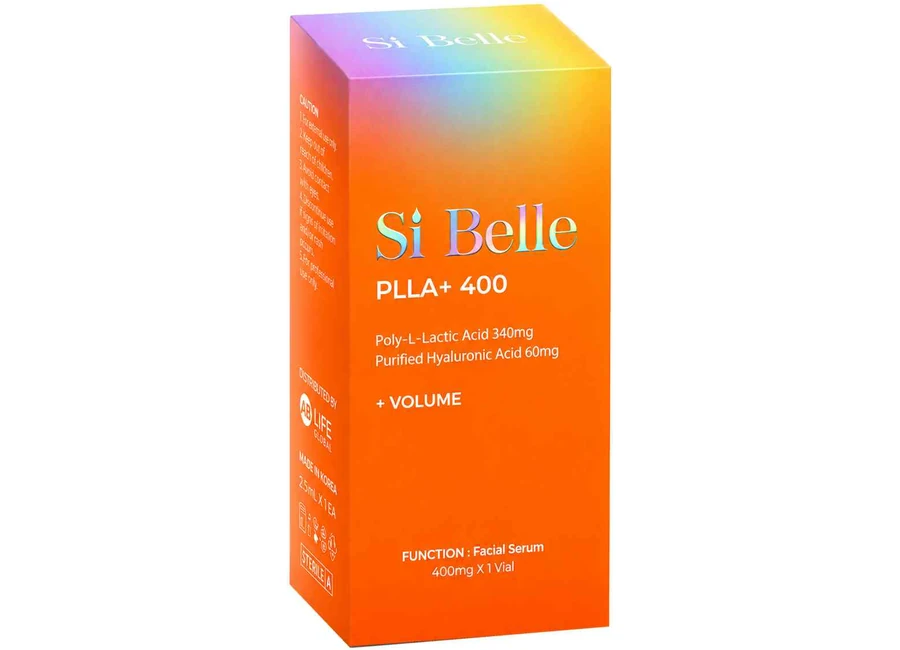
规格参数
| 项目 | 产品信息 |
|---|---|
| 型号 | PL-400 |
| PLLA | 340 mg |
| HA | 60 mg |
| 包装形式 | 400 mg / vial |
| 粒径 | ~30 µm |
| 针头 | 27G |
| pH | 4.0–7.0 |
| 渗透压 | 250–350 mOsm/kg |
| Normal force(来源标注) | 0.9–2.0 N |
技术与材料
资料以 PLLA 微球、组织反应及胶原形成解释配方理念。380 mg与400 mg型号的配方及配制参数不同,请勿混用两者规格。
专业人员配制信息
| 项目 | 产品信息 |
|---|---|
| 0.9%生理盐水 | 6 mL |
| 利多卡因 | 2 mL |
| 配制总量 | 8 mL |
| 水化时间 | 15–30分钟 |
使用注意事项与后续护理
资料描述24小时内的冷敷护理,以及7-3-3按摩原则:每次3分钟、每天3次、持续7天。请遵循治疗医生的个体化指导。
完整英文原始详情
下方保留产品指南的完整英文文本。上方本地化介绍及规格表是对资料的结构化整理;PDF 保留制造商或来源的原始文件。
Si Belle PLLA+ 400 combines 340 mg poly-L-lactic acid (PLLA) and 60 mg hyaluronic acid (HA) in a 400 mg vial. The PL-400 model is a two-component formulation containing 85% PLLA and 15% HA, with approximately 30 µm microspheres and a stated hydration time of 15-30 minutes.
A two-component formulation
The PL-400 table lists 340 mg PLLA and 60 mg HA per vial. These quantities total 400 mg; the visible Si Belle pack lists the same component amounts.
The formula contains 85% PLLA and 15% HA by weight.
| Component | Amount per vial | Share |
|---|---|---|
| Poly-L-lactic acid (PLLA) | 340 mg | 85% |
| Hyaluronic acid (HA) | 60 mg | 15% |
| Total | 400 mg | 100% |
PLLA material and formulation principle
PLLA is poly-L-lactic acid, a polymer formed from L-lactic acid units.
The supplied catalogue presents a general PLLA rationale linking tissue response, collagen formation and material degradation.
PL-400 technical specifications
| Parameter | PL-400 value |
|---|---|
| Product model | PL-400 |
| PLLA contents | PLLA 340 mg + HA 60 mg |
| Package | 400 mg / vial |
| Particle size | Approximately 30 µm (microsphere) |
| Needle | 27G |
| Infusion volume (0.9% NaCl saline) | 6 mL |
| Hydration time | 15-30 minutes |
| pH | 4.0-7.0 |
| Osmotic pressure | 250-350 mOsm/kg |
| Normal force (N) | 0.9-2.0 N |
Professional preparation overview
The PL-400 preparation table lists 6 mL of 0.9% normal saline plus 2 mL lidocaine, for a total preparation volume of 8 mL.
| Preparation component | Volume |
|---|---|
| 0.9% normal saline | 6 mL |
| Lidocaine | 2 mL |
| Total | 8 mL |
| Step | Preparation shown in the supplied catalogue |
|---|---|
| 1. Aluminium cap | Remove the aluminium cap from the vial. |
| 2. Alcohol swab | Clean with an alcohol swab. |
| 3. Saline transfer | An 18G needle and 10 mL syringe are shown for drawing up saline. |
| 4. Powder mixing | Syringe mixing is shown; a vortex mixer is also mentioned. |
| 5. Suspension mixing | Gentle vial agitation is shown. |
| 6. Lidocaine addition | The PL-400 table specifies 2 mL. The general source illustration states 1-2 cc. |
| 7. Syringe transfer | Transfer to a 1-10 mL syringe, as shown in the source. |
| 8. Blunt cannula | The source preparation illustration lists 26-30G and deep dermal/subcutaneous layers. |
Self-care for better results
The brochure describes two post-treatment care measures: cold-pack care and the 7-3-3 massage rule.
- Cold-pack care: within 24 hours after the procedure, the source advises an ice pack to reduce swelling.
- 7-3-3 rule: massage for 3 minutes, 3 times a day, for 7 days.
Before and after examples
The catalogue includes eight photograph sets across four pages.
Two facial sets show the labels Before, After 1 day, After 1 month and After 3 month.
The remaining sets show before/after views of facial contour, the buttock region, the eye area and the nasolabial region. No treatment interval is printed for these sets.
专业业务咨询
请注明公司、目的国、所选型号及数量。此操作将打开邮件应用,不会自动发送或保存咨询。
alexmoon@ictmedicalco.com ↗