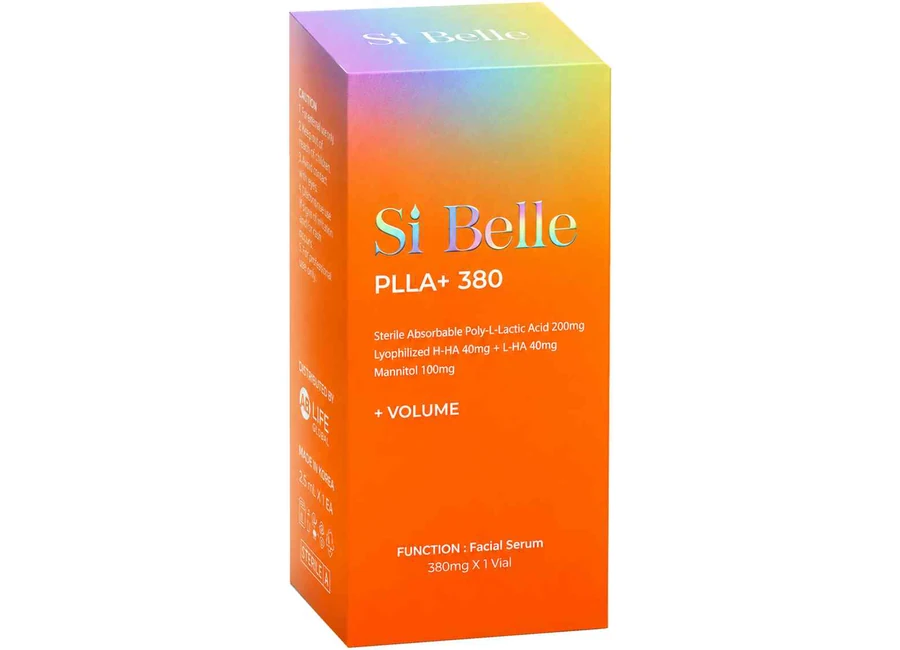
规格参数
| 项目 | 产品信息 |
|---|---|
| 包装形式 | 380 mg / vial |
| PLLA | 200 mg |
| H-HA | 40 mg |
| L-HA | 40 mg |
| 甘露醇 | 100 mg |
| 粒径 | 10–60 µm |
| 成分组成 | 52.6% PLLA / 21.1% HA / 26.3% mannitol |
技术与材料
资料以 PLLA 微球、组织反应及胶原形成解释配方理念。380 mg与400 mg型号的配方及配制参数不同,请勿混用两者规格。
专业人员配制信息
| 项目 | 产品信息 |
|---|---|
| 注射用水 | 9.5 mL |
| 利多卡因 | 2.5 mL / 2% |
| 水化时间 | 3小时 |
| 涡旋混合 | 开始及结束时各1–2分钟 |
制造商所述疗程
制造商描述2–3次疗程,间隔约4周,并报告初始疗程后预计效果持续18–24个月。具体方案由医生决定,持续时间存在个体差异。
使用注意事项与后续护理
配制及随访由治疗医生安排。可能出现疼痛、瘀青、肿胀或结节,初期外观可随配制液吸收而变化。
完整英文原始详情
下方保留产品指南的完整英文文本。上方本地化介绍及规格表是对资料的结构化整理;PDF 保留制造商或来源的原始文件。
Si Belle PLLA380+ combines 200 mg poly-L-lactic acid (PLLA), 40 mg high-molecular-weight hyaluronic acid, 40 mg low-molecular-weight hyaluronic acid and 100 mg mannitol in a 380 mg vial. The product information describes facial volume loss, wrinkles and contour concerns, and explains a progressive process involving PLLA microspheres, tissue response and collagen formation.
A four-ingredient formulation
Each vial contains PLLA 200 mg, H-HA 40 mg, L-HA 40 mg and mannitol 100 mg, for a total content of 380 mg.
The formulation combines PLLA microspheres with hyaluronic acid. PLLA-related tissue response is part of the manufacturer’s formulation rationale.
| Component | Amount per vial | Share stated in the catalogue |
|---|---|---|
| Poly-L-lactic acid (PLLA) | 200 mg | 52.6% |
| Hyaluronic acid: H-HA 40 mg + L-HA 40 mg | 80 mg total | 21.1% |
| Mannitol | 100 mg | 26.3% |
| Total | 380 mg | 100% |
PLLA material and microspheres
PLLA is poly-L-lactic acid, a polymer formed from L-lactic acid units. The supplied catalogue discusses biodegradation and the biological response around PLLA particles.
The product has a stated microsphere particle range of 10-60 µm. PLLA and HA are biodegradable materials.
Role and principle
The manufacturer describes a progressive process involving PLLA microspheres, tissue response and collagen formation.
| Stage | Description |
|---|---|
| 1. PLLA microspheres | Microspheres are introduced into the treatment area. |
| 2. Tissue response | The proposed process involves cell migration around the particles. |
| 3. Collagen formation | The manufacturer links this tissue response with collagen formation. |
Facial areas and treatment planning
The product information describes facial volume loss, wrinkles and contour concerns. Area selection and suitability are assessed by the treating clinician.
- Forehead
- Cheekbones
- Cheeks
- Nasolabial folds
- Chin
Professional preparation: 380 mg model
Preparation, treatment and follow-up are planned by the treating clinician for the individual patient. The following technical parameters are reproduced from the 380 mg model information.
| Parameter | Preparation details |
|---|---|
| Vial content | 380 mg |
| Water for injection | 9.5 mL |
| Lidocaine | 2.5 mL of 2% lidocaine |
| Hydration time | 3 hours |
| Vortex mixing | 1-2 minutes at the beginning and end |
Treatment schedule and reported duration
The manufacturer describes 2-3 sessions, approximately 4 weeks apart. The treating clinician determines the individual treatment plan.
The manufacturer cites an effect of approximately 18-24 months after an initial 2-3 sessions. This is a reported estimate; individual durability varies.
Aftercare and follow-up
Discuss swelling, skin changes and follow-up timing with your treating clinician.
Massage, cooling and other home-care measures should follow the treating clinician’s individual instructions.
Pain, bruising, injection marks and swelling may occur. Recovery and return to activities depend on the individual clinical response.
Nodules can occur and may require further treatment. The treating clinician assesses and manages individual concerns.
The manufacturer attributes some early volume to the preparation fluid. Swelling and appearance can change as that fluid is absorbed.
Questions and answers
| Question | Answer |
|---|---|
| Who is the facial treatment intended for? | The product information describes facial volume loss, wrinkles and contour concerns. Suitability is assessed for each patient. |
| What is in each vial? | PLLA 200 mg, H-HA 40 mg, L-HA 40 mg and mannitol 100 mg, for a total content of 380 mg. |
| How does it differ from an HA-only filler? | The formulation combines PLLA microspheres with hyaluronic acid. PLLA-related tissue response is part of the manufacturer’s rationale. |
| Are the polymer materials biodegradable? | PLLA and HA are biodegradable materials. Material characteristics do not replace an assessment of the finished product and patient. |
| What is the recommended treatment schedule? | The manufacturer describes 2-3 sessions, approximately 4 weeks apart. The treating clinician determines the individual treatment plan. |
| How long does the manufacturer report an effect? | Approximately 18-24 months after an initial 2-3 sessions. This is a reported estimate; individual durability varies. |
| What about recovery and daily activities? | Pain, bruising, injection marks and swelling may occur. Recovery and return to activities depend on the individual clinical response. |
| Can nodules occur? | Nodules can occur and may require further treatment. The treating clinician assesses and manages individual concerns. |
| Why can early appearance change after treatment? | The manufacturer attributes some early volume to the preparation fluid. Swelling and appearance can change as that fluid is absorbed. |
| How are bleeding or bruising addressed? | Bleeding and bruising are discussed in the product information. The treating clinician assesses and manages these concerns. |
Manufacturer application examples
The supplied brochure includes two nasolabial-region photograph sets: before and after 2 months; before and after 3 months.
专业业务咨询
请注明公司、目的国、所选型号及数量。此操作将打开邮件应用,不会自动发送或保存咨询。
alexmoon@ictmedicalco.com ↗